
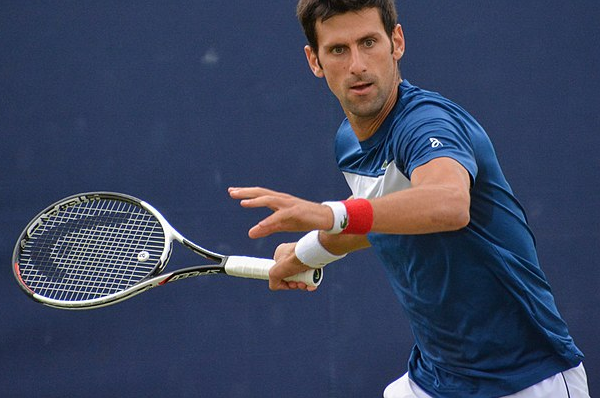
And so, in the end, Novak Djokovic wasn’t allowed to enter Australia. His dreams of winning a historic tenth title evaporated overnight; instead Rafa Nadal became the record-breaker. If only he’d consented to be vaccinated.
Why didn’t he? In the wake of the Australian immigration saga, lots of media stories have focused on his “weird beliefs”. Not a few have mentioned his belligerent assertions of Christian faith, and the wooden cross that hangs around his neck when he plays. They have often linked this to his advocacy of unusual therapies and bizarre physical disciplines. Christians are crackpots, hints the underlying subtext, and Djokovic is just an extreme example of a basket case.
There’s no doubt about the seriousness of the player’s Christian faith. He may be the wealthiest tennis star ever (he has made over £113 million) but he has determinedly ploughed it back into all sorts of charitable activities: a restaurant offering free food to the poor; education provision for disadvantaged children; renovation of schools, churches and other community resources. After the Australian episode, he went immediately to an Orthodox monastery for a while. The Serbian Orthodox church has invested him with its highest award, the Order of St Sava (which he describes as “the most important title of my life”) and he is a UNICEF Goodwill Ambassador. Before the Australian incident, many Christian websites pointed to Djokovic as an outstanding example of a man whose life has been transformed by Christ.
And yet… there’s the other side. Clearly he is deeply in love with his wife, but didn’t choose to marry her until she was five months pregnant (behaviour which the Orthodox church certainly doesn’t approve). On the tennis court, he has a long record of arrogant, undisciplined behaviour: racket throwing, arguments, exploiting the rules with prolonged medical time-outs, even causing injury to officials through his bad temper. (For this one, admittedly, he later apologized.) His eccentric theories about telekinesis and telepathy often sound more like New Age claims than Christian thinking, referring to “gifts from a higher order, the source, the god, whatever, that allows us to understand the higher power and higher order in ourselves”.
So what sort of Christian is Novak Djokovic? He rarely mentions Jesus, but he does get excited about the possibility of our minds transforming polluted water through the power of prayer and gratitude. He goes off to monasteries, but he has also made several pilgrimages to the Pyramid of the Sun, an ancient Bosnian site which is supposed to possess mystical healing agency. He is an unashamed Serbian nationalist, denying Kosovo’s right to independence, and has worrying connections to leaders connected with the 1995 Srebrenica massacre. Although he uses the phrase “Christian” about himself, he almost always qualifies it with another word – “Orthodox Christian”. As for many Serbs, religion and patriotic expansionism are inextricably entangled in his outlook.
It’s easy to criticize. But it’s important to remember the circumstances of his upbringing, as a child in a war-torn country, seeing unspeakable things which have haunted his imagination for years. Many commentators have seen a link between his intransigent behaviour, his insistence on independent, uncontrolled thinking, and his childhood experiences. When you add to this a lifestyle constantly lived out in the media spotlight – and enough wealth to allow you to espouse any eccentricity you wish – and an apparent lack of accountability to spiritual advisers or wise counsellors – perhaps it’s no wonder that stark, unexpected contradictions appear in his behaviour and opinions. Would I do better under the same pressures? I wonder.
What does it make me think? Three things.
First, that holding anyone up as a perfect example of shining faith is a risky thing to do. “There is not a righteous man on earth,” says Ecclesiastes, “who does what is right and never sins.” Evangelical websites are all too prone to exalt heroic figures as Christian objects of admiration, much in the same way as Catholics used to airbrush the stories of saints celebrated in mediaeval hagiography. While it’s true that the testimony of a life altered by encounter with Jesus can be powerful and persuasive, when you don’t really know the person concerned – when you’re simply basing your opinion on facts gleaned from the papers – you are liable to judge wrongly, to praise inappropriately, to produce a misleading account which can later be undermined.
Second, that people with awesome amounts of money and unfettered freedom of action are more likely to be “loose cannons” whose behaviour is likely to be erratic. I am in no position to judge the reality of Christian faith in (for example) Kanye West, Justin Bieber or Jurgen Klopp. (Or, for that matter, Novak Djokovic.) But I hope and pray that God is genuinely at work in their lives, despite the news stories I sometimes hear which mystify me and confuse the picture.
And third, that all Christians are a work in progress, not the finished article; moving “from one degree of glory to another” at different speeds as God endeavours to complete his sanctifying work in their lives. Some of them have the added burden of living out their struggles and temptations in the full glare of media publicity. And what they need from the rest of us is not our lionization, or our condemnation and criticism, but our prayers.
Image by Carine 06 on Flickr, via Wikimedia Commons. Licensed under CC-by-sa 2.0 .